在线debug/分析redis 1.0 源码
- 1、benchmark分析redis对于性能很佛系,基于单核的event loop。
- 2、rdb文件格式,了解持久化原理
- 3、从redis的104个testcase开始按照dfs顺序走读代码
- 4、redis的事件循环,了解redis-cli和redis-server的通信
- 5、彩蛋,基于redis的山寨版推特实现
- 6、master slave的实现原理
RDB文件格式
[dlx@localhost redis-1.0]$ ./redis-cli  -h 127.0.0.1  flushall
OK
[dlx@localhost redis-1.0]$
[dlx@localhost redis-1.0]$
[dlx@localhost redis-1.0]$ ./redis-cli  -h 127.0.0.1 set key1 abc
OK
[dlx@localhost redis-1.0]$ ./redis-cli  -h 127.0.0.1 set key2 abc
OK
[dlx@localhost redis-1.0]$
[dlx@localhost redis-1.0]$
[dlx@localhost redis-1.0]$ ./redis-cli  -h 127.0.0.1 rpush key3 1
OK
[dlx@localhost redis-1.0]$ ./redis-cli  -h 127.0.0.1 rpush key3 2
OK
[dlx@localhost redis-1.0]$ ./redis-cli  -h 127.0.0.1 rpush key3 3
OK
[dlx@localhost redis-1.0]$ ./redis-cli  -h 127.0.0.1 llen key3
3
[dlx@localhost redis-1.0]$
[dlx@localhost redis-1.0]$
[dlx@localhost redis-1.0]$ ./redis-cli  -h 127.0.0.1 sadd key4 a
1
[dlx@localhost redis-1.0]$ ./redis-cli  -h 127.0.0.1 sadd key4 b
1
[dlx@localhost redis-1.0]$ ./redis-cli  -h 127.0.0.1 sadd key4 a
0
[dlx@localhost redis-1.0]$
[dlx@localhost redis-1.0]$ ./redis-cli  -h 127.0.0.1 keys key*
key2 key3 key4 key1
[dlx@localhost redis-1.0]$ save
如下图所示,上面这一通操作之后rdb文件中保存了4个key以及对应的数据。
  Offset: 00 01 02 03 04 05 06 07 08 09 0A 0B 0C 0D 0E 0F
00000000: 52 45 44 49 53 30 30 30 31{FE}[00]00 04 6B 65 79    REDIS0001~...key
00000010: 32 03 61 62 63[01]04 6B 65 79 33 03 C0 01 C0 02    2.abc..key3.@.@.
00000020: C0 03[02]04 6B 65 79 34 02 01 61 01 62 00 04 6B    @...key4..a.b..k
00000030: 65 79 31 03 61 62 63{FF}                            ey1.abc.
上面中括号括起来的字段标记了数据类型。1.0版本只有string,list,set三种数据类型。上面还标记了两处大括号括起来的标记,用来标记是SELECTDB的东西还是EXPIRETIME相关的东西,以及EOF。
具体怎么解析的,大家看代码就了然了 static int rdbLoad(char *filename)
/* Object types */
#define REDIS_STRING 0
#define REDIS_LIST 1
#define REDIS_SET 2
#define REDIS_HASH 3

/* Object types only used for dumping to disk */
#define REDIS_EXPIRETIME 253
#define REDIS_SELECTDB 254
#define REDIS_EOF 255
至于save的时候做了啥,注意这里的rename操作。也就是先写到一个临时的rdb文件然后rename过去。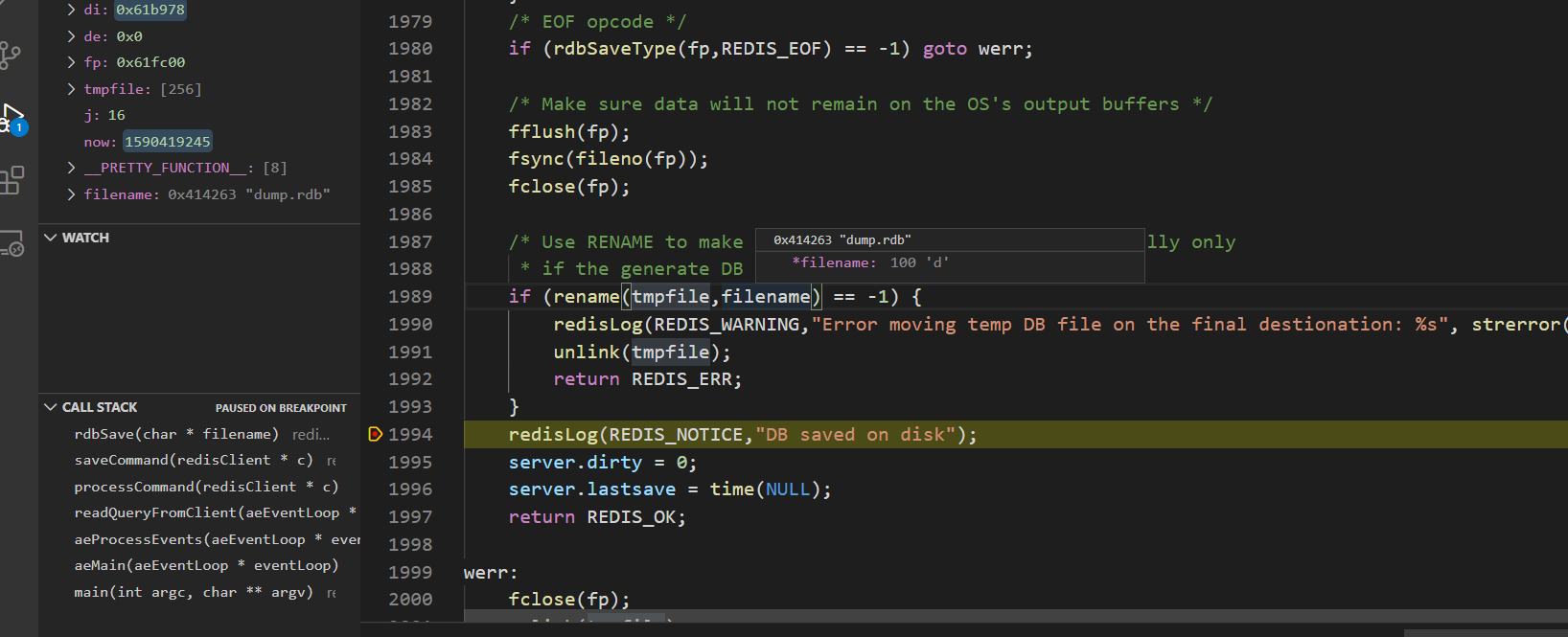
redis的事件循环
redis里面的事件分为两类:文件事件和时间事件。
/* State of an event based program */
typedef struct aeEventLoop {
    long long timeEventNextId;
    aeFileEvent *fileEventHead;
    aeTimeEvent *timeEventHead;
    int stop;
} aeEventLoop;
文件事件(file event)
这里的文件就是1 + N个fd。即1个redis server的fd(会触发accept事件),以及N个redis client连接的fd(会触发read和reply事件)。
文件事件本质上是文件的读写事件,是通过select系统调用获取的。
#include <sys/select.h>

int select(int nfds, fd_set *readfds, fd_set *writefds,
                  fd_set *exceptfds, struct timeval *timeout);

select() allows a program to monitor multiple file descriptors,
       waiting until one or more of the file descriptors become "ready" for
       some class of I/O operation (e.g., input possible).  A file
       descriptor is considered ready if it is possible to perform a
       corresponding I/O operation (e.g., read(2), or a sufficiently small
       write(2)) without blocking.
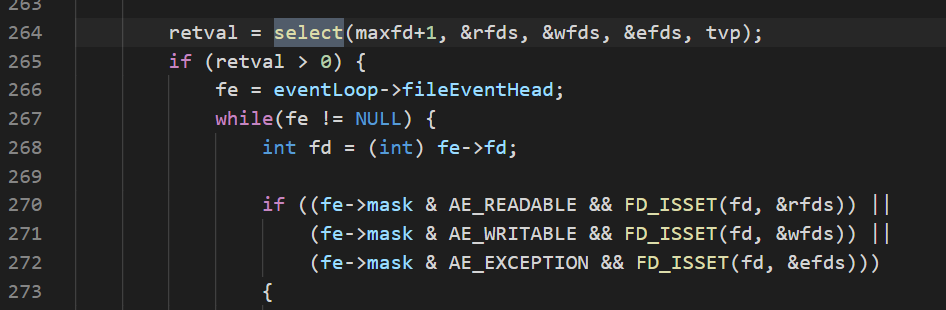
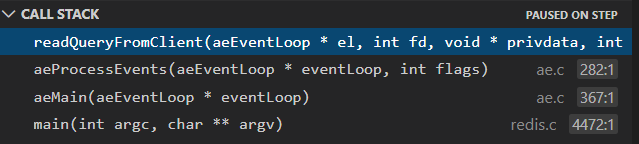
事件都有对应的事件处理函数,可以在对应的事件handler中加断点,观察事件时怎么被处理的。
情况1:读请求内容(read)
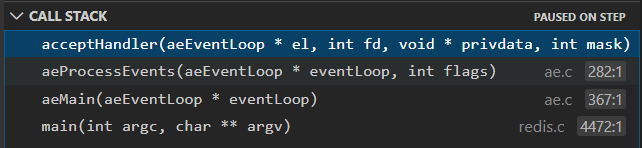
情况2:接受请求(accept)
情况3:回复(reply)

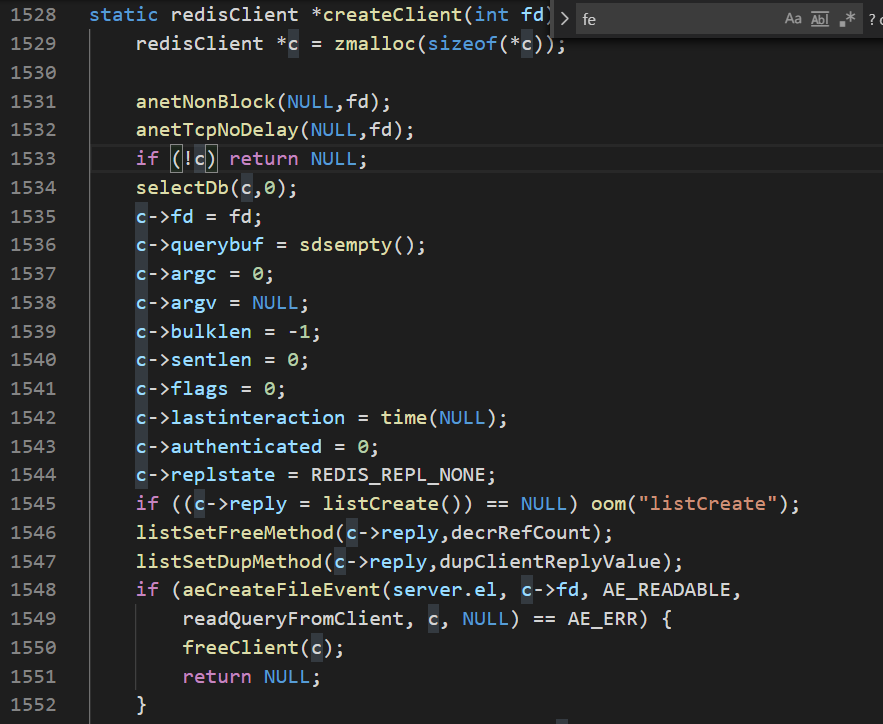
Accept处理过程中会衍生出Read事件(因为接受了客户端请求,紧接着就是读取客户端请求内容),如下图所示,注意下图中的handler为readQueryFromClient。
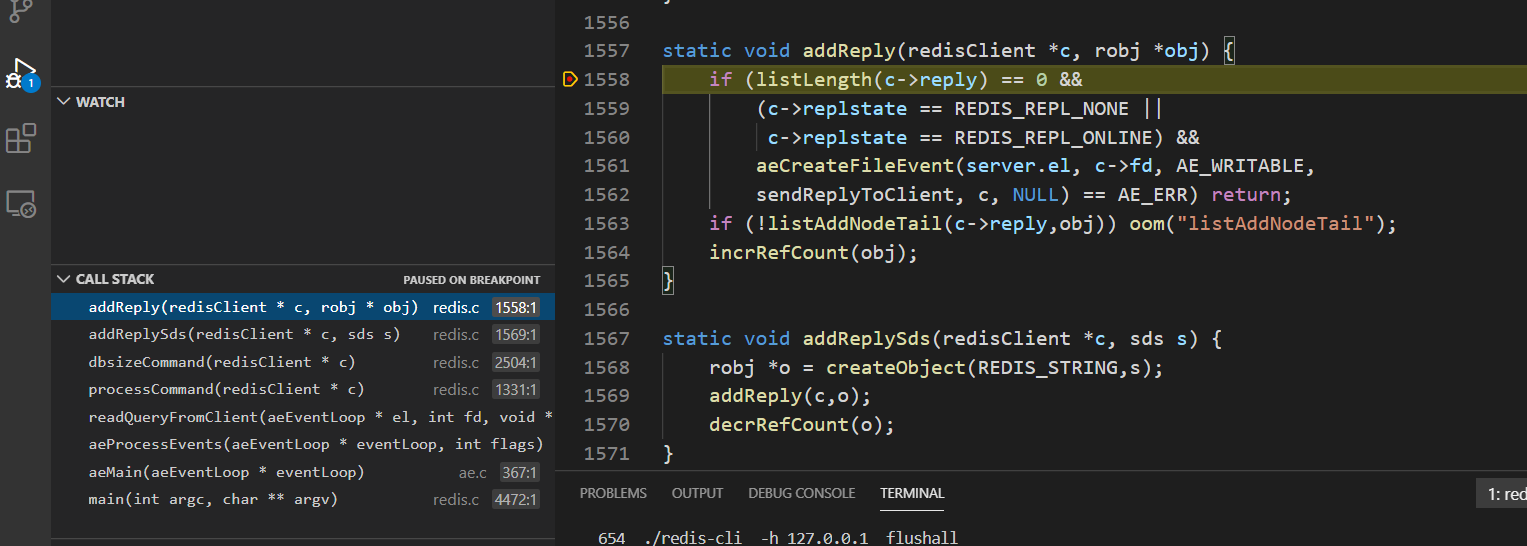
Read事件的处理过程中又会衍生出Reply事件(因为读取请求了,紧接着就是执行请求内容,紧接着考虑是否要回复结果)。
我们随便选择一个命令(比如dbsize),从调用栈能够清晰看出执行的流程。
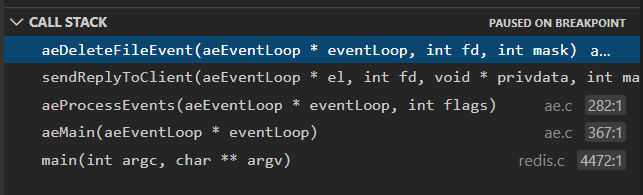
可以看出sendReplyToClient将会在另外单独的一个Event中进行处理。事实上也确实如此:
从调用栈可以发现有个叫redisClient的数据结构,在processEvents之后的重重调用中都充当着入参的角色,这个玩意应该就是服务端给每个client存的会话数据了。
aeEventLoop这个数据结构就是事件列表了,某一时刻redis的所有事件(accept,read,reply,time)都挂在这里面。
这4种事件又分为两类:
- file event(数据结构为
aeFileEvent):包括accept,read,reply - time event(数据结构为
aeTimeEvent):只有time
显然read,reply这些事件是关联到某个client的(因此aeFileEvent.clientData指向某个redisClient)。并且read,reply事件在handler处理结束之后就会从事件列表中删除(通过指定redisClient的fd从列表中删除相同fd的事件)。
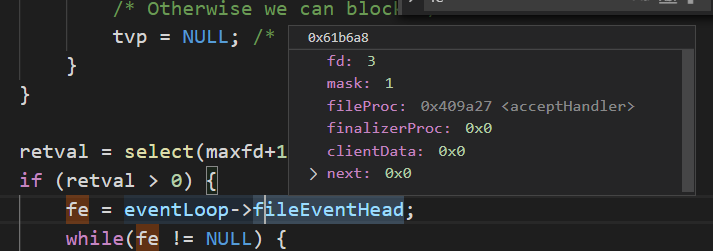
accept事件是redis server初始化的时候加入到事件列表中的,fd为server的fd(server.fd = anetTcpServer(server.neterr, server.port, server.bindaddr);),因此accept事件将会一直存在与列表中,从始至终。
时间事件(time event)
可以搜索相关代码 aeCreateTimeEvent(server.el, 1000, serverCron, NULL, NULL); 主要是redis sever的定时任务。
benchmark
redis benchmark的代码也是基于上面的事件循环写的。先构造若干个client,同时加入到event loop列表,循环N次之后通过stop标记停止event loop。(注意:benchmark的时候因为是模拟压测,因此没有删除事件的操作)。
redis本身叫做远程字典服务(远程+字典)目前看来redis使用事件循环来实现了所谓的远程,即多客户端并发连接操作。
显然,单线程的event loop再牛皮也只能把一个cpu核跑满,虽然现在吞吐可以跑到300000 requests per second。
所以redis显然不是从极致性能出发去设计的。
====== SET ======
  10004 requests completed in 0.03 seconds
  50 parallel clients
  3 bytes payload
  keep alive: 1

83.90% <= 0 milliseconds
100.00% <= 1 milliseconds
303151.53 requests per second

====== GET ======
  10013 requests completed in 0.04 seconds
  50 parallel clients
  3 bytes payload
  keep alive: 1

80.81% <= 0 milliseconds
100.00% <= 1 milliseconds
250325.00 requests per second

====== INCR ======
  10004 requests completed in 0.04 seconds
  50 parallel clients
  3 bytes payload
  keep alive: 1

81.07% <= 0 milliseconds
100.00% <= 1 milliseconds
263263.16 requests per second

====== LPUSH ======
  10006 requests completed in 0.04 seconds
  50 parallel clients
  3 bytes payload
  keep alive: 1

82.06% <= 0 milliseconds
100.00% <= 1 milliseconds
277944.47 requests per second

====== LPOP ======
  10005 requests completed in 0.04 seconds
  50 parallel clients
  3 bytes payload
  keep alive: 1

82.12% <= 0 milliseconds
100.00% <= 1 milliseconds
277916.69 requests per second